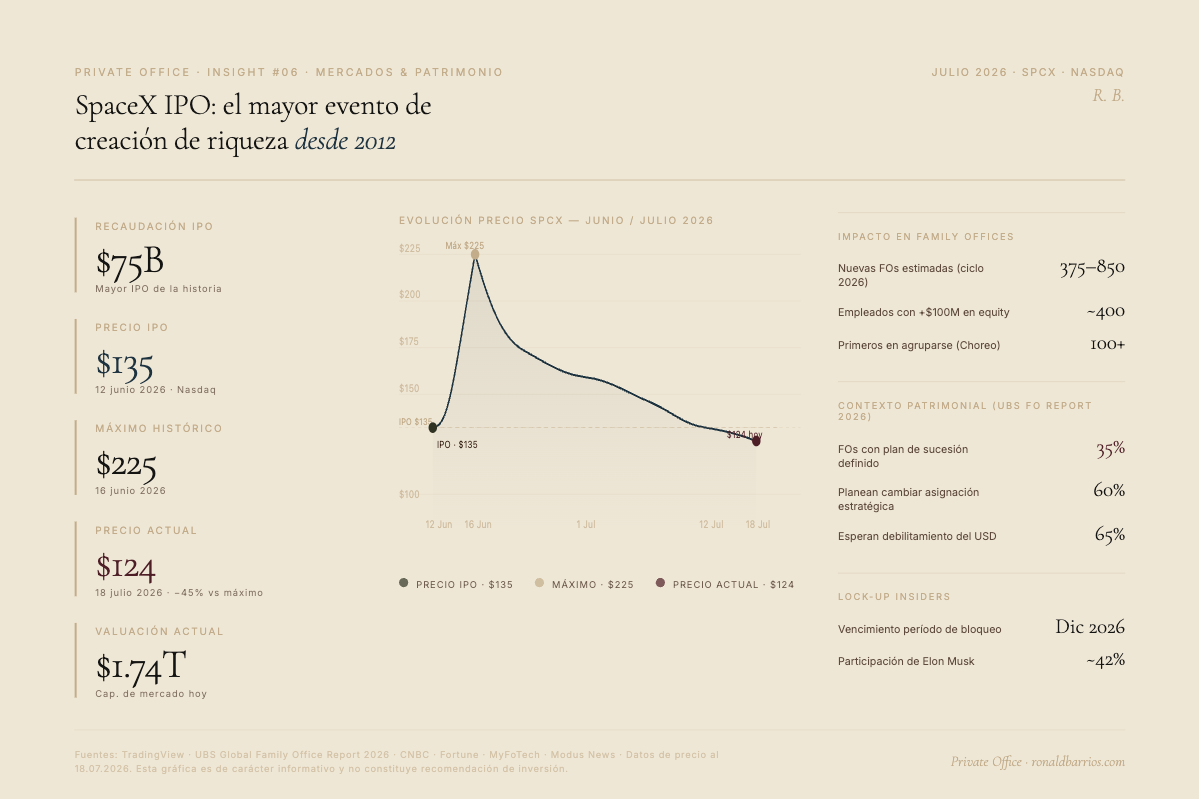
On June 12, 2026, something markets had spent years anticipating finally happened: SpaceX debuted on the Nasdaq under ticker SPCX, raising approximately $75 billion at a $1.77 trillion valuation. The largest public offering in history.
On day one, the stock rose 19%. At its peak on June 16, it touched $225.64. Today it trades around $124 — 39.5% below that high, and close to the $135 IPO price. The market, as always, is processing the distance between narrative and numbers.
But there's a story the market headlines aren't telling well. It isn't the story of SPCX. It's the story of what's happening to people who suddenly went from an engineer's salary to tens of millions of dollars in liquid stock.
That story has direct implications for the wealth world worth observing carefully.
A compressed wealth-creation window
Industry estimates suggest the 2026 tech IPO cycle — which includes SpaceX, and potentially Anthropic and OpenAI in the coming months — could create between 375 and 850 new family offices. That's not a small number. The total count of single family offices worldwide sits around 10,000. This summer alone could grow that universe by 4% to 8% in a matter of months.
Of the thousands of SpaceX employees who became millionaires, an estimated 400 received more than $100 million in equity. Some, far more. These are engineers, technicians, project managers — people who chose below-market salaries in exchange for equity in a company nobody was certain would ever go public. They bet for years. Now they hold liquid capital.
And the wealth management industry knows it. Teams from private banks, wirehouses and RIAs headed to California, Texas and Florida within days. The competition for these new clients is real and intense. More than 100 employees with combined assets between $1 and $5 billion have already grouped together to negotiate bulk terms with the firm Choreo, aiming to reduce advisory costs and redirect more resources to philanthropy.
It's an interesting collective move. But what draws my attention most isn't the collective movement. It's what happens individually.
The most dangerous moment in someone's financial life
There's a paradox the financial industry rarely says out loud: the moment of greatest wealth risk isn't when you have no money. It's when you suddenly have too much — without history, without structure, without knowing quite what to do with it.
Capital accumulated slowly has time to develop judgment. Capital that arrives suddenly arrives before the judgment does.
A SpaceX engineer who spent ten years earning $120,000 a year with options now worth $30 million has no reason to already know — yet — how post-IPO stock lock-ups work, the tax implications of concentration, the risks of holding 80% of net worth in a single asset, the difference between a commission-based advisor and a fee-only one, or how to build a structure that outlives their own professional life.
Not knowing these things isn't a flaw. It's simply the reality of someone who built wealth doing something that wasn't wealth management.
The problem is that the financial system moves much faster than the education of those who need it. Banks call before the lock-up expires. Advisors offer products before the client understands their own needs. Investment opportunities appear before an allocation policy exists.
And in that vacuum, decisions get made that can cost a great deal.
What the data says about preparedness
There's a number from the UBS Global Family Office Report 2026 that should be in every wealth management conversation this summer: only 35% of family offices have a defined succession plan.
We're not talking about new millionaires. We're talking about structures that have operated for years, sometimes decades. Families with lawyers, accountants, managers. And still, two out of three haven't formalized how what they've built gets transferred.
Now imagine that figure applied to someone who just received liquidity for the first time in their life.
The same report notes that 65% of family offices expect confidence in the dollar as a reserve currency to decline over the next twelve months, and 60% plan changes to their strategic asset allocation. These are numbers that reflect structural uncertainty: even the most sophisticated players are adjusting their frameworks.
For someone new to the wealth world, that context makes decisions even more complex.
The risk of concentration and the lock-up
One of the most common mistakes in liquidity events is confusing paper value with real liquidity.
SPCX rose 19% on its first day. Those holding shares before the IPO saw extraordinary numbers on their statements. But most employees with significant equity couldn't sell. The standard lock-up period is 180 days from the IPO date, meaning large-scale insider sales won't begin until approximately December 2026.
During that window, the stock went from $225 to $124. Those who calculated their net worth at the peak and made life decisions based on that figure — bought a house, committed capital to other projects, planned donations — may now be looking at a considerably different number.
This isn't an argument against SpaceX or the people who received that equity. It's an illustration of why paper wealth isn't the same as structured wealth, and why the first question shouldn't be "how much do I have?" but "how much of this is actually mine, and under what conditions?"
A new generation of capital, a new decision profile
What makes this new wave different is something Fortune described well this week: the "IPO Bros" don't think or act like the clients the wealth management industry is used to.
They're more risk-tolerant. They carry a founder's mindset. Many already had partial liquidity through secondary share offerings before the IPO — this isn't their first experience with capital. And they're more inclined to invest in startups, technology, and unconventional assets.
That's not a bad thing. But it does require a different kind of advisory relationship. Not the classic 60/40 asset allocation model. Not the traditional family office built to preserve intergenerational wealth over decades. Something in between — more flexible, able to adapt to a high-risk profile sitting on a wealth base that's still consolidating.
The wealth management market will have to evolve to serve this generation. The first to understand that will hold a considerable advantage.
What this says about capital in Latin America
There's a dimension of this story I find particularly relevant for the region.
Latin America frequently produces capital in ways similar to what this cycle describes: concentrated liquidity events, wealth that arrives quickly from businesses, company sales, inheritances, or in some cases commodities. The pattern is recognizable, even if the context differs.
And the mistakes repeat too: concentration in a single asset, absence of corporate structure, mixing personal and business wealth, postponing the succession conversation because it feels uncomfortable, investment decisions made without an allocation policy.
What the SpaceX cycle reveals at global scale is a truth the region sometimes learns the costly way: wealth that arrives quickly needs structure just as quickly. Not perfect. Not necessarily sophisticated from day one. But with clear direction on what to preserve, what to grow, and what to leave behind.
The question that matters
SpaceX's IPO is not an investment opportunity in SPCX. That's a separate conversation, with its own analysis, its own risks, and its own timing.
What it is, is an opportunity to observe a wealth phenomenon of unusual scale — and learn from it.
Capital that arrives suddenly tests something built over years: the judgment to decide what to do when there's no real urgency, but the financial system insists there is.
The answer isn't to move fast. It's to move well.
And moving well starts with a question no bank will ask on the first call: what do you want this capital to do for you twenty years from now?
That answer doesn't come from a spreadsheet. It's built in a conversation.
Sources consulted
- Family Office Insider / GPFO — July 2026
- UBS — Global Family Office Report 2026
- J.P. Morgan Private Bank — 2026 Global Family Office Report
- CNBC — SpaceX employee group creates low-fee wealth management option with Choreo
- CNBC — New SpaceX millionaires are reinventing the business of managing large wealth
- Fortune — This summer's hottest IPOs are minting a new class of ultra-high-net-worth 'IPO Bros'
- MyFoTech — The SpaceX, Anthropic & OpenAI IPOs: What They Mean for Family Offices in 2026
- Modus News — A Surge in New Family Offices Fueled by Mega IPOs
- AI-CIO — How Will Upcoming Mega-IPOs Impact Family Office Formation and Growth
- TradingView — SPCX quote and IPO data
- Crain Currency — How family offices are positioning themselves for an IPO rebound
This content is general commentary and does not constitute financial, legal, tax, or investment advice.
R. B.