Growing also means understanding who you depend on
Clients, banks and jurisdictions: the relationships that support what we are building.
A good client can change the course of a business. They bring work, make hiring possible and help us consider larger premises. When that relationship works well, it is natural to want to look after it and keep growing together.
Over time, that client can also become so important that a conversation about their next orders ends up determining the plans of the entire business. That is a good moment to pause. The relationship is still good. What has changed is how much depends on it.
I am interested in the part of growth that sometimes gets left out of the conversation. We celebrate how much we sold, how much our wealth increased and how many opportunities came our way. Afterwards, it can be a little harder to ask what needs to keep working for all of that to last.
Looking at how we grow
The Ministry of Industry and Commerce (MIC) reported that cumulative exports under the maquila regime rose by 26% from January to August 2026 compared with the same period in 2025. Mercosur accounted for 77% of those exports. These figures relate to that regime and period, rather than to all Paraguayan exports. Source: MIC, September 11, 2026.
The figures let us look at which markets support that expansion and how much they account for. A large share going to one region may reflect valuable commercial relationships, proximity and knowledge of the market. Understanding a dependency comes before assessing it; a percentage on its own is not enough.
In a hypothetical example, a business has revenue of 100, and one client contributes 45. The following year, revenue reaches 120 and that same client buys 54. Sales have increased, but the client's share remains at 45%.
The business may be in a better position. Perhaps it has a higher margin, a longer contract or a stronger relationship. Growth alone, however, has not changed the composition of its revenue.
Sales also tell only part of the story. Some clients buy a great deal but leave little margin. Others buy less, pay on time and make it easier to organise work with peace of mind. Knowing the difference helps us decide where to put our effort and which relationship needs an alternative.
The bank is part of the business too
The same question arises when we look at how money comes in and goes out.
Keeping receipts, payments and reserves with one bank can be convenient. We know the team, the processes are familiar and there are fewer accounts to reconcile. That convenience has real value.
Now imagine a disruption: access that needs to be restored, a transfer that requires review or a technical problem that takes time to resolve. If that bank is the only available route, one incident can start taking over the entire day. We do not need to assume a bank failure to ask how we would keep paying an important obligation.
A second banking relationship can provide another route, provided it has a clear purpose and can actually be used. An account opened years ago, with outdated details or access that cannot be recovered, may help far less than we imagine.
It also helps to look behind the apps. Two different brands do not prove that the money is deposited with different institutions. That independence needs to be checked in the service documentation. The FDIC explains the relationships between non-bank apps and banks in the United States. That model is a specific reference, rather than a description of every digital account.
Another jurisdiction needs to be understood
Something similar happens with international accounts. The country associated with a brand, the account's currency and the institution we enter into an agreement with may be different things.
If the aim is to reduce a geographic dependency, it matters where the institution providing the service is incorporated, which rules govern the relationship and which channels are available to resolve a problem. Documentation, residency requirements and the cost of maintaining that relationship matter too.
An account in another jurisdiction can serve a useful purpose. Its value depends on how it fits the income, expenses and plans of the person using it. Opening several accounts without understanding them can add work while leaving the dependency we wanted to reduce unchanged.
I prefer to start with something more concrete: which route would be available if the usual one were interrupted, who could help me and what I need to keep up to date to use it.
Giving trading a place of its own
Concentration can also sit within our expectations. If the money for everyday expenses depends on the outcome of the next trades, that pressure enters the market with us.
A trading account needs a purpose and a limit of its own. The question is how much risk we are willing to take without compromising obligations that already have a due date. That decision deserves to be made before trading, while we can still think calmly.
Spreading capital across platforms does not, by itself, address the risk of holding similar positions on all of them. We may have changed intermediaries and still depend on the same market movement.
The exercise is similar for a business, a bank or a portfolio: recognising which relationships we want to preserve, which carry too much weight and where we lack a workable alternative.
Growth brings new commitments. Paying attention to them is also a way of looking after what we have built, and the people who depend on it.
If your most important relationship were interrupted tomorrow, which parts of your life or business could you keep going?
General perspective. The examples are hypothetical. This does not constitute financial, legal, tax or investment advice.
About the image: prompt and references
Original generation prompt (English)
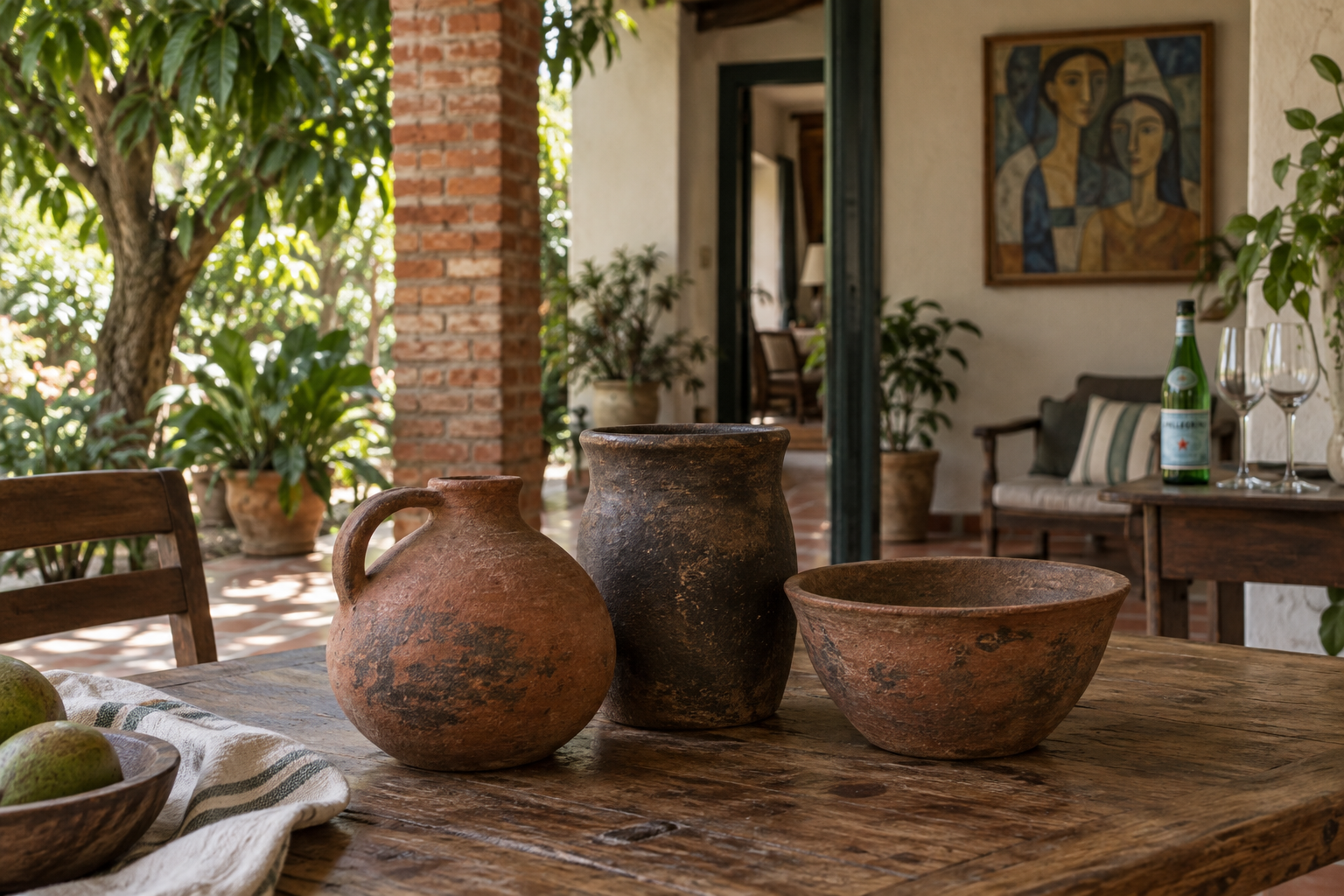
Use case: photorealistic-natural. Editorial conceptual photograph for Ronald Barrios personal brand, distinctly contemporary Asuncion Paraguay, warm natural daylight, actual lived-in materials, subtle use wear, warm mineral ivory forest green burnt clay and natural wood, human calm realistic mood. No people, no money imagery, no trading screens, no luxury showroom, no tropical resort, no flags or stereotypical souvenir decor. No overlaid words, watermarks, slogans. Artwork and objects are digital recreations in an imagined interior, not documentation of an actual person's house. National art should look naturally collected, small and secondary. Landscape 3:2 image. Foreground wooden table under a shaded Paraguayan gallery/patio: three distinct simple hand-built everyday clay vessels with patinated reddish and dark clay, traditional Ita pottery context; these are original generic vessels, not attributed to an artist. Different vessels form a restrained metaphor for complementary relationships. Background limewashed wall, weathered red brick column, terracotta floor, shaded mango canopy. A small framed painting in the historical Paraguayan modernist visual language of deceased artist Olga Blinder, subdued ochre faces and blue washes, hanging far back and softly out of focus. A green glass S.Pellegrino water bottle and two empty fine Riedel stemmed glasses on a rear side table, casually placed not centered and not advertisement. Camera at table height 50mm, objects occupy middle horizontal band, tactile quiet depth, believable Asuncion home atmosphere.
Visual references